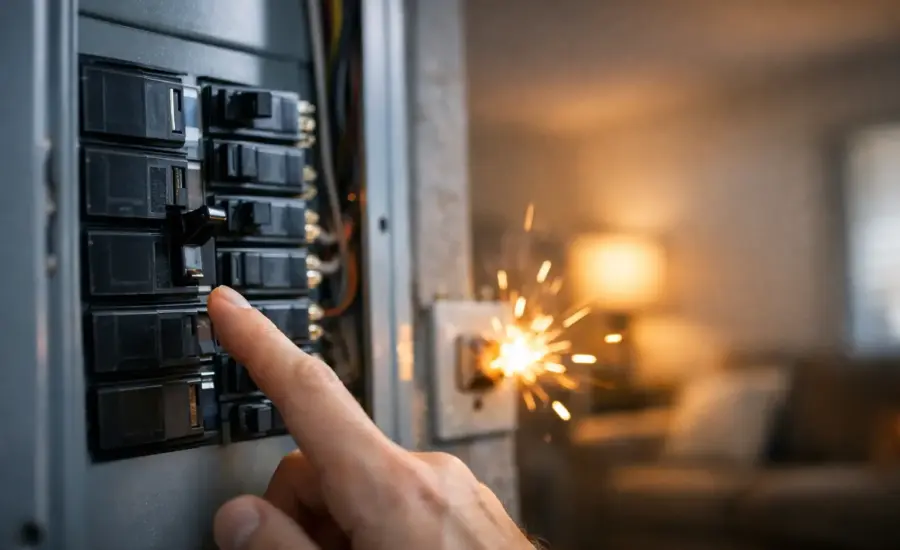
A breaker that trips once while you are running a space heater, hair dryer, and microwave may be doing exactly what it was designed to do. But a breaker that will not stay on, trips without an obvious reason, or shuts down part of a home repeatedly deserves attention. Understanding what causes circuit breaker trips can help homeowners and property managers respond safely, protect appliances, and know when the issue calls for a licensed electrician.
What a Circuit Breaker Is Telling You
A circuit breaker is a safety switch inside the electrical panel. It cuts power when it detects more current than the circuit can safely handle or when electricity is flowing in an unsafe way. That interruption helps reduce the risk of overheated wiring, equipment damage, and electrical fires.
A tripped breaker usually sits between the full ON and OFF positions. To reset it, move it firmly all the way to OFF first, then back to ON. If it immediately trips again, leave it off. Repeated resets can worsen a wiring problem or damage the breaker.
The reason matters. A single trip after using several high-demand appliances may point to an overload. A breaker that trips the moment it is reset may signal a short circuit, ground fault, faulty appliance, or damaged wiring.
The Most Common Causes of Circuit Breaker Trips
Circuit overloads
Overloads are the most common and often the easiest cause to identify. Every circuit has a limit. Many standard household branch circuits are rated for 15 or 20 amps, while larger appliances may use dedicated circuits with higher ratings.
An overload happens when too many devices draw power from the same circuit at the same time. In an older home, one circuit may serve several outlets, lights, and rooms, making the problem less obvious. A portable heater, window AC unit, toaster oven, vacuum, curling iron, or power tool can be enough to push that circuit past its limit.
If a breaker trips only when certain combinations of appliances run, reduce the load. Move one appliance to an outlet on a different circuit or avoid operating high-wattage items together. Extension cords and power strips do not create more electrical capacity. They only distribute the power already available on that circuit.
Short circuits
A short circuit occurs when a hot wire touches a neutral wire or another unintended conductive path. Electricity takes that low-resistance path quickly, causing a sharp surge of current that trips the breaker.
Signs can include a burning smell, dark or discolored outlet covers, buzzing, popping sounds, or a breaker that trips as soon as it is switched on. A damaged appliance cord, loose outlet connection, chewed wiring, or deteriorated insulation can cause a short.
Do not keep testing a suspected short circuit. Unplug devices on that circuit if it is safe to do so, leave the breaker off, and arrange for an electrician to inspect it. If you see smoke, sparks, or signs of fire, move away from the area and call emergency services.
Ground faults
A ground fault happens when a hot wire contacts a grounded surface, such as a metal electrical box, appliance casing, or ground wire. Like a short circuit, it can create dangerous current flow and trip the breaker.
Ground faults are more likely in areas with moisture: kitchens, bathrooms, laundry rooms, garages, basements, exterior outlets, and pool or spa areas. They can also result from damaged cords or worn appliances.
Many newer homes use ground-fault circuit interrupter protection, often called GFCI protection, in these locations. A GFCI outlet may trip before the breaker does. Check for a tripped GFCI outlet and press its reset button only after unplugging anything that may be wet or damaged. If it will not reset or keeps tripping, it needs professional evaluation.
Arc faults and loose connections
An arc fault occurs when electricity jumps through air across a loose or damaged connection. It may happen inside a wall, outlet, switch, junction box, or appliance cord. Because arcing can generate significant heat, modern electrical systems may use arc-fault circuit interrupter, or AFCI, breakers to detect it.
AFCI breakers can trip because of damaged cords, aging wiring, loose terminals, or certain appliance issues. They may also trip after a device is plugged in or when a light switch is used. This is not a problem to solve by replacing the breaker with a standard one or installing a larger breaker. The protection is there for a reason.
A failing appliance or electrical device
Sometimes the house wiring is fine, but one appliance is not. Refrigerators, sump pumps, washing machines, dishwashers, disposal units, HVAC equipment, and power tools can develop internal faults that trip a breaker.
A practical test is to unplug every device on the affected circuit. Reset the breaker, then plug items back in one at a time. If the breaker trips when a specific item is connected or turned on, stop using that item until it has been repaired or replaced.
This approach has limits. Do not pull out hardwired appliances, remove covers, or handle equipment that is wet, hot, damaged, or giving off an odor. Those situations call for an electrician or an appliance repair professional.
An aging or defective breaker
Breakers can wear out, especially in older electrical panels or panels exposed to heat, moisture, or corrosion. A weak breaker may trip below its rated load, feel unusually hot, refuse to reset, or fail to stay in the ON position even after appliances have been unplugged.
A defective breaker is possible, but it should not be assumed first. The breaker may be responding correctly to an issue elsewhere in the circuit. A qualified electrician can test the circuit load, inspect connections, and determine whether the breaker itself needs replacement.
Safe Steps to Take Before Calling for Service
Start by noting what was running when the power went out. Was a space heater on? Did the disposal, microwave, or vacuum start at the same time? Did the trip happen during rain, after using an exterior outlet, or when an appliance cycled on? These details help identify a pattern.
Next, turn off or unplug accessible devices served by that circuit. Reset the breaker once. If it holds, reconnect devices gradually and avoid overloading the circuit. If it trips again with everything unplugged, or if it trips the instant it is reset, keep it off.
Avoid common shortcuts. Never replace a breaker with one of a higher amperage unless an electrician has confirmed the wiring is rated for it. Never tape a breaker in the ON position, bypass a GFCI, or rely on a power strip to solve repeated trips. Those choices can turn a manageable electrical issue into a fire risk.
For rental properties, document the affected rooms, appliances, and timing, then report the issue promptly through the appropriate maintenance process. Property managers should treat recurring trips as a maintenance priority, particularly where tenants rely on refrigerators, medical equipment, heating, cooling, or sump pumps.
When a Local Electrician Is the Right Call
Call a qualified local electrician when a breaker trips repeatedly, trips immediately after resetting, affects a major appliance, or comes with heat, odor, sparking, buzzing, discoloration, or moisture. Professional help is also appropriate after flooding, rodent damage, renovation work, or when an older home needs additional circuits for modern electrical use.
An electrician can trace the circuit, test outlets and connections, measure loads, inspect the panel, and recommend a fix that matches the home. The solution might be as simple as replacing a damaged receptacle or appliance cord. In other cases, it may involve adding a dedicated circuit, repairing concealed wiring, upgrading GFCI or AFCI protection, or addressing an outdated panel.
When comparing providers, ask whether they are licensed and insured, whether permits are needed for the scope of work, and whether they will explain the source of the problem before repairs begin. A dependable local professional should give you clear next steps rather than simply resetting the breaker and moving on.
A breaker trip is a warning, not an inconvenience to override. Treat the pattern seriously, use the circuit more carefully when an overload is clear, and get trained help whenever the cause is uncertain. That small pause can protect the people, property, and equipment that depend on your electrical system every day.